The External Thermal Insulation Composite System (ETICS)
The External Thermal Insulation Composite System (ETICS) has recently established itself as one of the best solutions for cladding facades and roofs. Its success is due to its excellent insulation capacity, ease of application, and durability, making it a preferred option for both new construction and the renovation of existing buildings.
This system is based on the installation of prefabricated insulating panels, which are adhered to the walls using adhesives and mechanical fasteners and covered by a decorative exterior cladding that not only protects the structure but also enhances the building’s aesthetics. Its versatility makes it ideal for extreme climates, as it offers efficient thermal protection, reducing the impact of environmental conditions on the building.
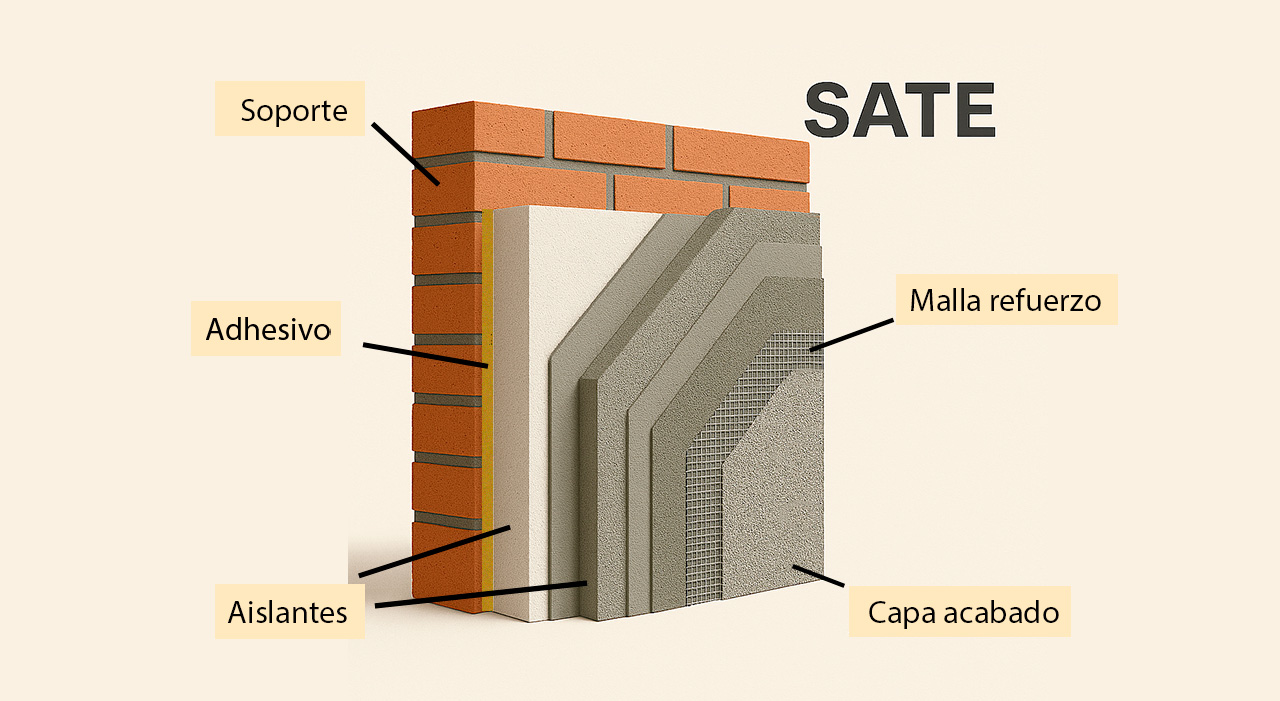
The ETICS is composed of several elements that work together to ensure optimal insulation and long-lasting durability. The main components include:
- Adhesive mortar: Used to fix the insulation panels to the façade, ensuring their stability and strength.
- Insulation panels: They can be made from a variety of materials, including:
- Expanded polystyrene (EPS): Lightweight, thermally efficient, and easy to install.
- Extruded polystyrene (XPS): Similar to EPS, but with greater mechanical strength and lower water absorption.
- Mineral wool: Noted for its excellent thermal and acoustic insulation, as well as its fire resistance.
- Cork: Natural and sustainable, it is an environmentally friendly option with outstanding insulating properties.
- Polyurethane: A synthetic material with high insulating capacity and structural strength.
- Reinforcing mesh: Helps prevent the formation of cracks and fissures in the exterior cladding, ensuring the integrity of the system.
- Finishing layer: Can be made from a variety of materials, such as acrylic coatings or mortars, among others. This layer provides additional protection and improves the aesthetics of the building, allowing for customization according to the owner’s needs.
Benefits of ETICS
ETICS represent an ideal insulation solution compared to others, as the panels cover all the walls of the building, protecting it from external weather conditions. This provides a barrier against weather conditions and prevents the formation of thermal bridges, which are often difficult to eliminate with other insulation methods.
In addition, ETICS offers multiple advantages that make it an ideal option for any type of construction, whether new construction or renovation projects. Some of its benefits are:
1. Energy Savings and Comfort
The main advantage of ETICS is the energy savings it provides. By minimizing heat losses and gains, heating and air conditioning consumption is significantly reduced, allowing interiors to maintain a constant temperature throughout the year. This creates a more comfortable environment for residents, reducing temperature variations and improving the feeling of well-being.
2. Reducing the ecological footprint
The ETICS contributes significantly to environmental sustainability, as by reducing energy consumption, it also reduces CO₂ emissions. This allows buildings to comply with European and Spanish regulations related to energy efficiency and environmental protection.
3. Easy installation
The materials used in ETICS are lightweight and flexible, making them easy to install and adapt to any type of façade. Furthermore, as it is a relatively simple system, it does not require a large amount of specialized labor, reducing installation costs.
4. Acoustic insulation
In addition to protecting against outside temperatures, ETICS also improves the building’s acoustics, significantly reducing external noise. This is especially beneficial in urban areas or places with high levels of noise pollution, providing a quieter and more comfortable environment for occupants.
5. Aesthetic Renovation and Property Enhancement
In addition to helping with functional aspects, another key benefit of ETICS is its ability to improve the visual appearance of buildings. By incorporating a new layer of decorative cladding, the building’s appearance can be renewed without the need for complex renovations. This not only allows the original aesthetic to be preserved but also adapts to new architectural trends. As a result, buildings that implement ETICS increase their value in the real estate market, attracting potential buyers and investors.
6. Protection against condensation and external agents
The materials used in ETICS are usually water- and fire-resistant, meaning they are resistant to water and fire. This prevents the formation of condensation on the walls, reducing the risk of damp and mold.
7. Durability and Easy Maintenance
Thanks to the high-quality materials used and proper installation, ETICS have a remarkably long lifespan. It is estimated that, with proper maintenance, the system can maintain its properties for 30 to 50 years, guaranteeing a long-term investment.
Importance of ETICS in energy certification
Implementing ETICS in a home or building significantly improves its energy rating. In Spain, having an Energy Efficiency Certificate is mandatory for renting or selling a property. Efficient insulation, such as that offered by ETICS, contributes to obtaining a better rating, which increases the value of the property and generates economic benefits for owners.